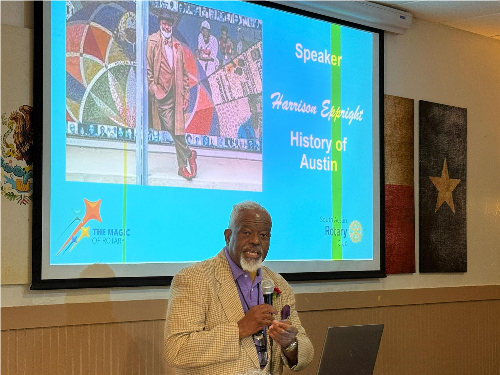
Guest Speaker Harrison Eppright - History of Austin Part 2
The history of African Americans in Austin dates back to 1839, when the first African American, Mahala Murchison, arrived. By the 1860s, several communities were established by freedmen that later became incorporated into the city proper.
Historic Six Square comprises six square miles of East Austin, originally created in 1928 as the Negro District by the Austin City Council. The Six Square district is bordered to the north by Manor Road, to the south by Seventh Street, to the east by Airport Boulevard and to the west by Interstate 35. It’s dotted with notable historic homes, churches, commercial buildings, schools, cemeteries and parks.
At one time there was a Black community on Red River St in the after math of the Civil war. There were black churches and businesses. Only one building in this part of Austin still stands, the Jeremiah Hamilton House, a triangular shape building where now the Austin Symphony Orchestra calls home.
In 1996, Lieutenant Governor Bob Bullock attended the funeral of former U. S. Representative Barbara Jordan. He noted that while the cemetery was still being used regularly that it had become run down. He organized a full-scale renovation and restoration project. The project included the construction of a visitor's center and gallery, pond, columbarium wall, and a memorial plaza.
State Highway 165 is a state highway in the U.S. state of Texas that runs to and within the Texas State Cemetery in Austin. The 0.5-mile-long route is the shortest primary state highway in Texas, and it is perhaps the only one partially locked at night.