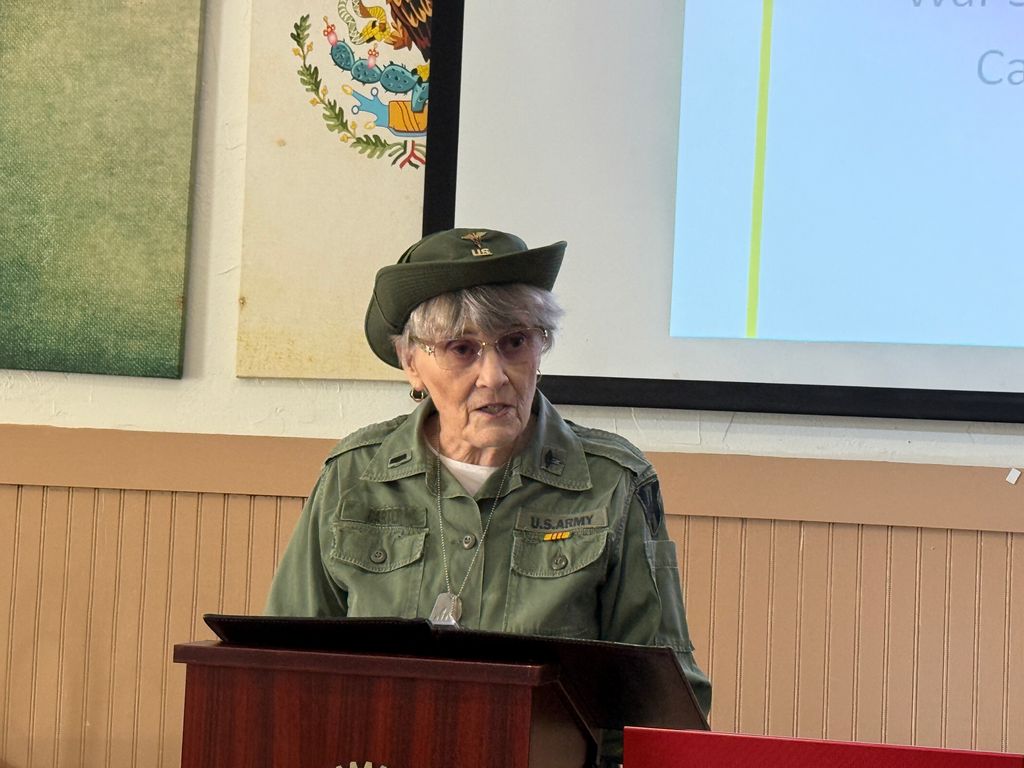
Megan Murphy served for a year as an OR nurse at the 24th Evac in Long Binh Vietnam beginning in 1969. Her story was full of facts, yet compelling and emotional. Many of us were in tears by the end of it.
Here’s a little bit of it:
In 1968, entering my senior year of Nursing School at Central Maine General Hospital in Lewiston Maine, I had run out of money. When an Army Recruiter visited our nursing school and offered us a 2 for 1 program, we would enlist in the Army now, receive pay during our Senior year, then owe the Army two years of service upon graduation, I welcomed it and enlisted.
Since Vietnam I’ve had therapy and have continued in Hospital Nursing, primarily in the OR and ER, until 2002 when I graduated from UT Austin with a Masters in Nursing as a Family Nurse Practitioner.
The stories I tell reflect my experience which in many ways are similar to the other 7,000 nurses who served in hospitals during the Vietnam War. It took me years to write these stories and even longer to speak about them.
In Country: It was too risky to speak, if you talked about it, you would feel it, and if you allowed yourself to feel it, you could not have continued to do your job.
And At Home: If you talked about it, you couldn’t have endured the pain.
However, I decided in 2022 that I owed it to the men who died to tell their stories so intertwined with my own.
January 1969
7 AM Surgery
24th Evac Hospital
Long Binh Post, Vietnam
Tough calls:
The boy on the OR table, draped in sterile green cloth is too pale. Two surgeons and a scrub nurse frantically try to identify and stem the steady flow of bleeding coming from his torso, right arm and both legs. There are too many holes to count.
Suction! Sponge. Suture-Tie-Cut.
Suction. Sponge. Cautry .
At the head of the OR table the circulating nurse hears the thrum of ventilations delivered by anesthesia to still functioning lungs. Yes, the blood remains red.
Looking up she sees her 4th unit of life saving blood, encased within the transfusion pressure cuff is secure on its IV pole. Her eyes follow the blood tubing down to a large bore IV in the boy’s only intact arm. Good. The site is still good. Reaching up and alternating her hands, she notes that both arms are now numb, but her adrenaline is high and she vigorously squeezes the black rubber bulb. Observing the blood bag is empty; she swiftly replaces it with plasma and continues to pump.
She watches as the mound of once green drapes, partially covering the boy, blooms with ever widening scarlet circles, the circles steadily welling up become rivulets of red rivers coursing down the once sterile folds.
There they follow the drapes in a steady drip to the cracked cement floor before making their way to the drain.
Change hands. Pump.
Check the IV site. It’s still good.
Check the boys face, it remains ghostly white.
Change hands again, squeeze and pray.
The blood-loss flow is in sync with her deliberate pumping actions. The metallic odor of blood fills her nostrils.
Change hands, pump, and replace the empty bag.
The OR team is focused, skilled and coordinated. Still they are losing this boy.
The hidden mine he triggered on patrol wasted too much flesh, pierced too many vital vessels to repair and cut short his young life. When the inevitable outcome arrives there is silence.
The chief surgeon calls the time.
Activity ceases but the silence continues.
No words are exchanged as each team member takes a deep breath and prepares to move on.
Two corpsmen begin the solemn business of undraping and transferring the boy’s body to the holding morgue.
Removing their masks and gloves the surgical team deposits their blood soaked green cloth gowns in the hamper and move to the foot faucet to wash their shower shoes and bloodied feet, then to the sink to scrub their hands and face.
They will shed their saturated scrubs in the dressing room and put on a clean dry set before taking a moment to get a cup of coffee, and then, head back to the OR.
The boy was the first case of the day. There will be more.
I was the circulating nurse and that was my first case on my first day at the 24th and my introduction to war surgery.
The immediacy of this unreal world of death and dismemberment assaulting all the senses, had an urgency in which the goal was to survive intact; physically, mentally, and emotionally.
One doesn’t adjust to war, War is thrust upon you.