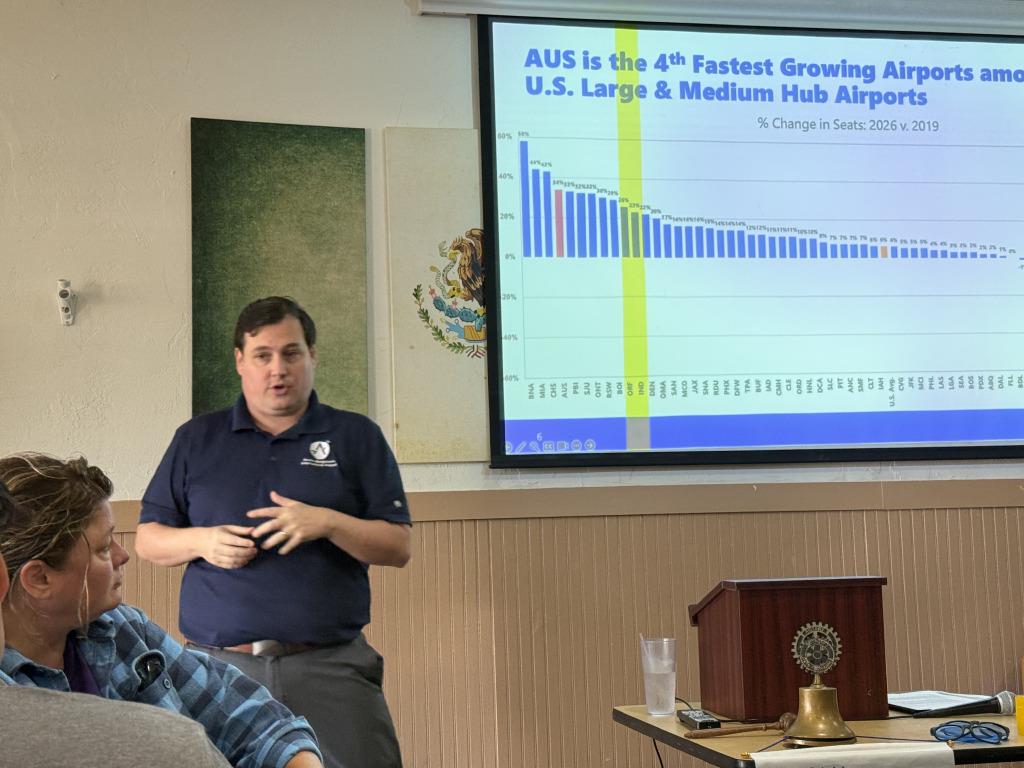
Bryce leads efforts at Austin-Bergstrom International Airport to connect the business community and key stakeholders with the fourth fastest growing airport in the country. His presentation is titled “Journey with AUS: The Future of Central Texas’ Airport."
The airport was moved from the Mueller location to the former Bergstrom Air Force Base location. It opened for commercial use in 1999. One of the biggest benefits of this location was the 12,500-foot runway built by the Department of Defense that still accommodates all planes today. When originally constructed, the airport had 25 gates to serve 11 million annual passengers. In 2017-2019 the terminal was expanded to 34 gates to serve 15 million annual passengers. That number was reached in 2018, and the passenger levels are over 21 million now in the same terminal designed for 15 million.
Bryce works with the business community to plan the airport growth. The business community is surveyed to determine where they need routes for travelers and ensure the airport will accommodate them. The model is working. In 2008 both San Antonio and Austin handled 8.8 million passengers. Due to this collaboration, Austin handled 21.7 million passengers in 2025, while San Antonio handled 11 million passengers.
This growth has required the Austin-Bergstrom International Airport to implement a $5 billion expansion program to reshape every facet of the airport. Roadways are being expanded, a new parking garage is being built allowing for 7,000 new parking spaces, and a new arrival and departure hall will be built. They are reinventing the ticketing area to represent the way people travel now. Since most passengers bypass the ticket counter, those will no longer be front and center. Passengers will go through TSA and arrive at what is now the Barbara Jordan Terminal. Concourse B, a new one added to the current two, will be accessed through a tunnel. This expansion will be delivered piece by piece since it is being built over the existing footprint, so starting in January the airport will be a construction site, while still functioning as a full-service airport. This project will enhance Austin's connections to the world and drive our economy.