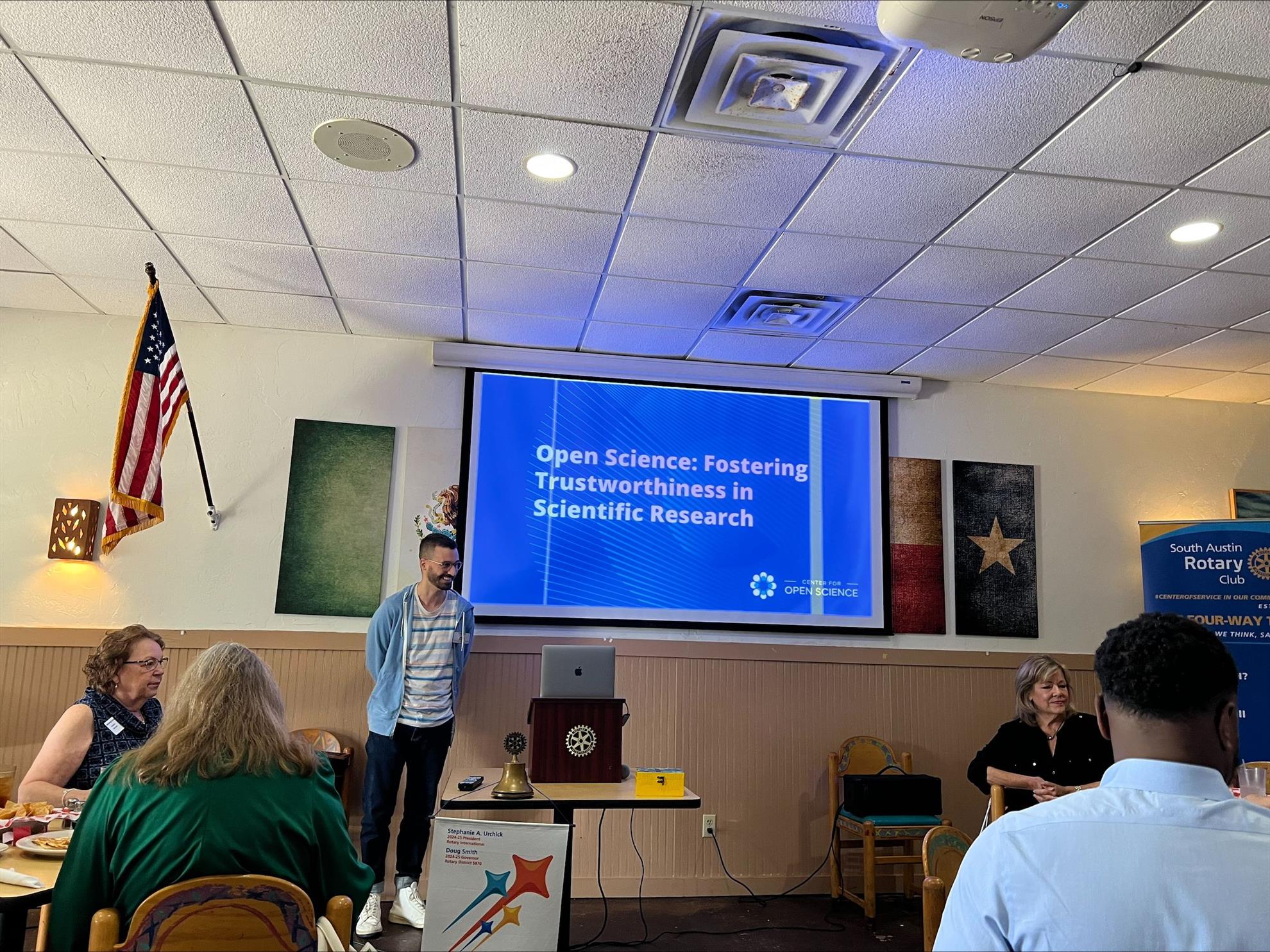
Our speaker is Terry Foor, Director of Development with the Center for Open Science (COS) since June 2022. The goal of open science is to make scientific research accessible to all .
Terry holds degrees in political science and sociology from Western Michigan University and the University of Oklahoma. He is especially interested in the intersection of open science and open source software. Terry lives in Austin, Texas with his wife and two cats. He is an active community volunteer and Rotarian.
The Center for Open Science (COS) was founded in 2013 to start, scale, and sustain open research practices that will democratize access to research, improve inclusion of all stakeholders, enhance accountability to research integrity, facilitate the self-corrective process of science, expand transparency and sharing of all research content, and improve research rigor and reproducibility. They envision a future scholarly community in which the process, content, and outcomes of research are openly accessible by default.
Strategy for Culture Change
COS’s Theory of Change recognizes that academic research is a social system, and that starting and scaling behavior change requires a systems-based intervention strategy. That means that every organization and participant in the research culture is an agent of stasis or change. And, to succeed in aligning scholarly practices with scholarly values, we must solve the coordination problem and ultimately activate everyone. But, no realistic strategy for behavior change can expect to activate everyone all at once.
COS’s strategy is to catalyze innovators and early adopters as the beachhead for change in a scholarly community by providing tools to make it possible to do the new behaviors. Then, making early adopters’ behavior visible and aspirational initiates changing community norms about how science should be done. That, combined with training and ensuring that the behaviors are fit for purpose, brings the behaviors into the mainstream. To scale and sustain those emerging norms, publishers, funders, and institutions align their incentives and policies so that researchers are rewarded and ultimately required to do the behaviors.
Make it Possible
The open-source Open Science Framework (OSF) makes it possible for researchers to improve rigor, transparency, and sharing of all their work across the research lifecycle.
Make it Easy
OSF is constantly evolving with user-centered product development to integrate into researchers' daily workflows. Training and customization ensures that the tools are fit-for-purpose for all kinds of research.
Make it Normative
Grassroots organizing activates champions to adopt new practices and engage their community. Targeted communications such as badges make their new behaviors visible to others.
Make it Rewarding
Journals and funders to realign incentives with Rigor and Transparency Initiatives using Registered Reports, a publishing format where peer review happens prior to data collection.
Make it Required
The Transparency and Openness Promotion (TOP) Guidelines provide and promote a policy framework for aligning values, incentives, and policies for journals, funders, and institutions.
Academic journal publications (articles" or "papers") are the currency of scholarly research.
What is research misconduct?
- Fraud: intentionally fabricating research data or analysis results
- Misconduct vs. Disconduct
- Mismanagement of research data
- Improper data collection or analysis techniques
- "P-Hacking"
What is the solution?
- Rigor
- Transparency
- Reproducibility/replicability (Verifiability)
Integrity/trustworthiness: that's open science!
OSF has
- 815,000 unique registered on 6 continents
- 105,868 new public projects registrations, and preprints in 2024